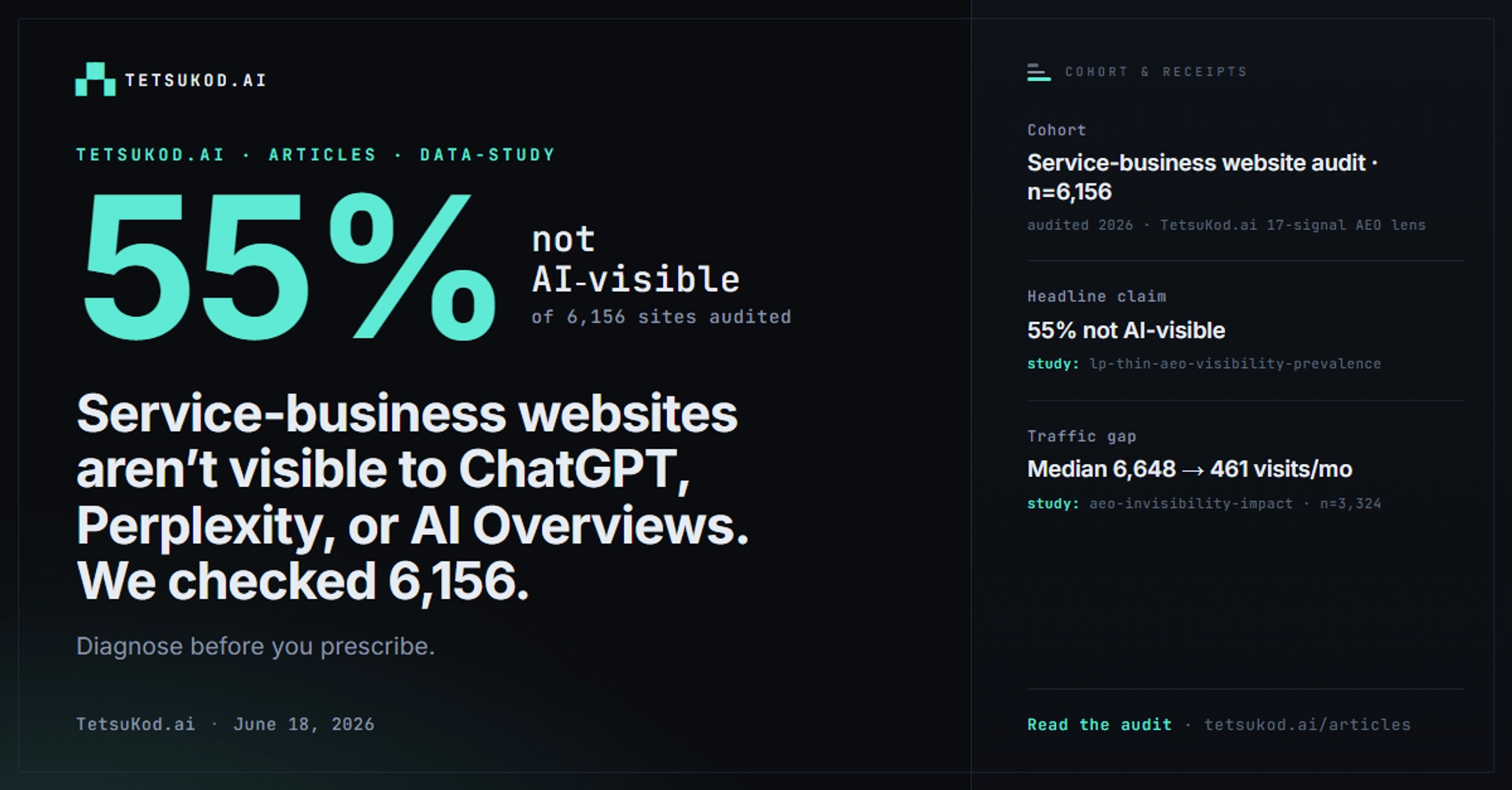
55% of service-business websites aren't visible to ChatGPT, Perplexity, or AI Overviews. We checked 6,156.

We audited 6,156 service-business websites against a 17-signal Answer Engine Optimization (AEO) scorecard. 55% aren't clearly visible to ChatGPT, Perplexity, or Google AI Overviews. The 45% that are pull roughly 14× the median organic traffic of the 55% that aren't — a gap that shows up in every industry we tested, and at every business size from single-operator shops to large enterprises.
TetsuKod.ai has audited thousands of SaaS and local service business websites, crunched the numbers, and published the data for full transparency.
Every claim below ships with the study slug behind it.
Published 2026-06-18 · cohort audited 2026.
Why can't my service business be found on ChatGPT, Perplexity, or Google AI Overviews?
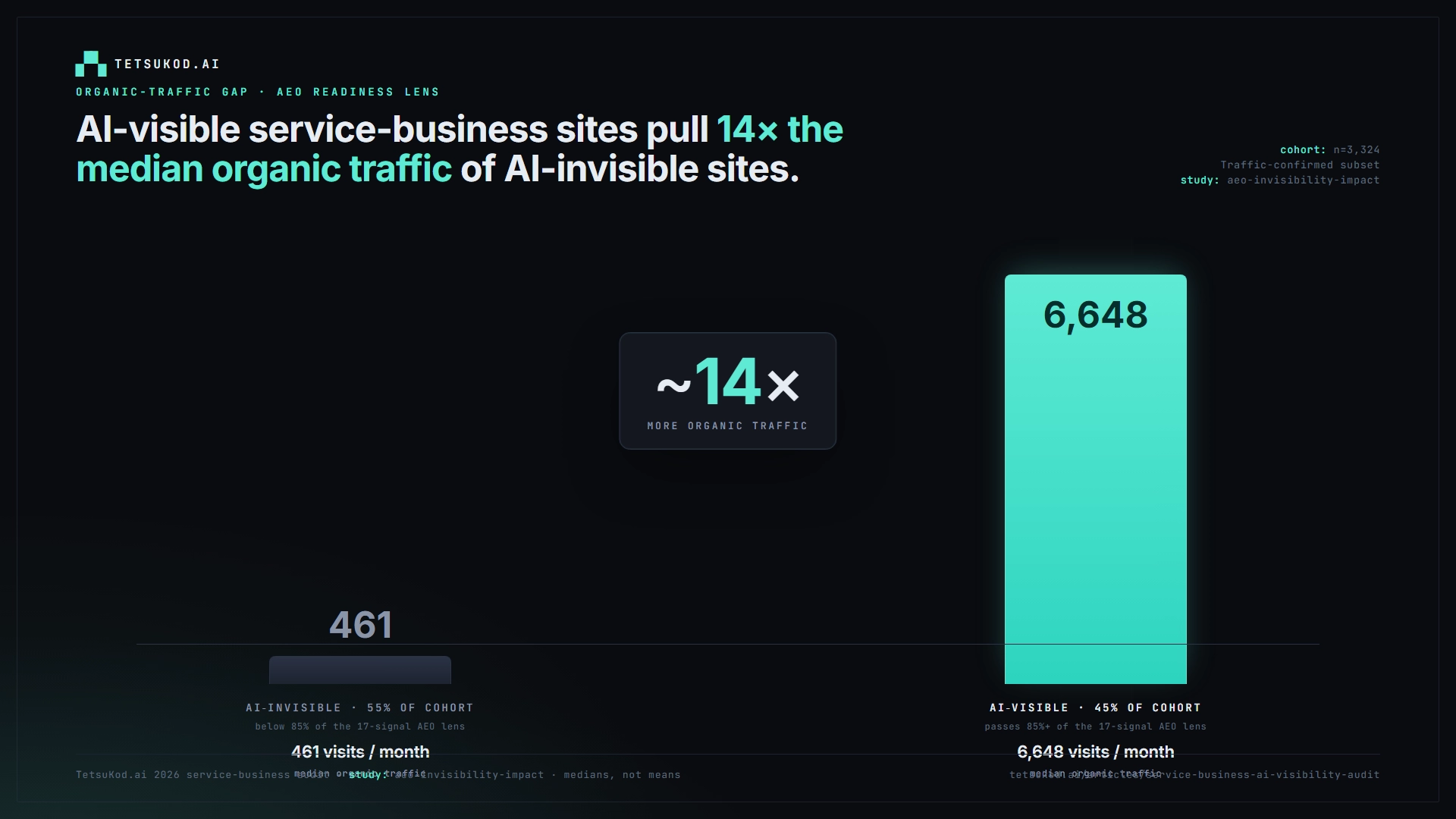
Because most service-business websites are missing the signals the AI engines look for. We audited 6,156 service-business websites in 2026. 55% fall below the basic AI-readability bar. Across the 3,324-site subset where we could measure organic traffic, the median AI-visible site pulled 6,648 organic visits per month. The median invisible site pulled 461. That's a 14× gap, and it shows up in every industry we tested.
The gap is biggest in five verticals: home service, addiction treatment, cosmetic surgery, medical practice, and roofing. In all five, the AI-ready businesses are pulling far more search traffic than the ones without.
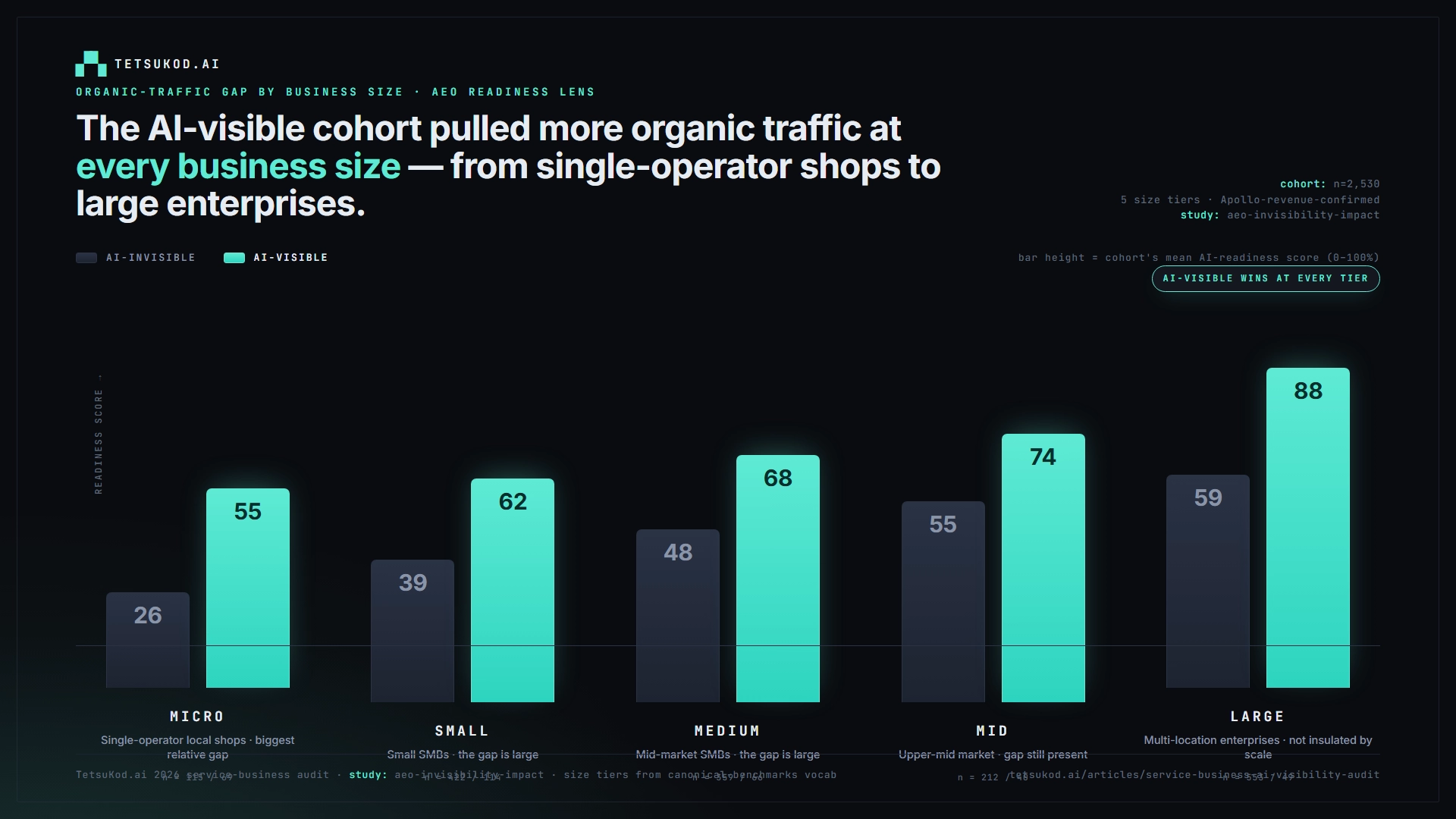
The gap also held at every business size we measured, from single-operator shops to large enterprises. The biggest relative gap shows up at the smallest end.
About 3% of sites actively block AI crawlers in their robots.txt file. Most of those blocks aren't on purpose — they're firewall defaults left in place by whoever set up the site. The bigger problem isn't blocking. It's that the site simply isn't readable.
What is Answer Engine Optimization, and why does it matter for a service business?
Answer Engine Optimization (AEO) is what makes your website readable by AI tools — ChatGPT, Claude, Perplexity, Google AI Overviews, and the next wave of AI search.
When a potential customer asks one of these tools "best HVAC company near me?" or "is the roofer down the street reliable?", the AI quotes content from websites that pass specific readability checks. Sites that pass get quoted by name. Sites that don't get skipped entirely.
Service businesses depend on intent-driven traffic — someone searches because they need a roofer right now. As more of those searches move from Google's blue links to AI answers, businesses that aren't AI-ready lose customers they used to capture. TetsuKod.ai's 2026 audit of 6,156 service-business websites found 55% are in that "not AI-ready" cohort.
How do I check if my service-business website is AI-visible?
Scan it for free at tetsukod.ai/scan. Enter your domain and start the AEO readiness quiz — it tests your knowledge of how AI engines read websites. While you take it, the scanner is auditing your site against 120+ signals in the background, building a full scorecard. The moment the quiz finishes you see two scores side by side: your quiz result, and your site's free AEO readiness score across the 17-signal lens this article is based on. After the scan completes, the full Indexability breakdown — every signal in that category, deeper than the 17-signal AEO lens — lands in your inbox.
The 17 AEO-specific signals we used for this audit fall into three groups:
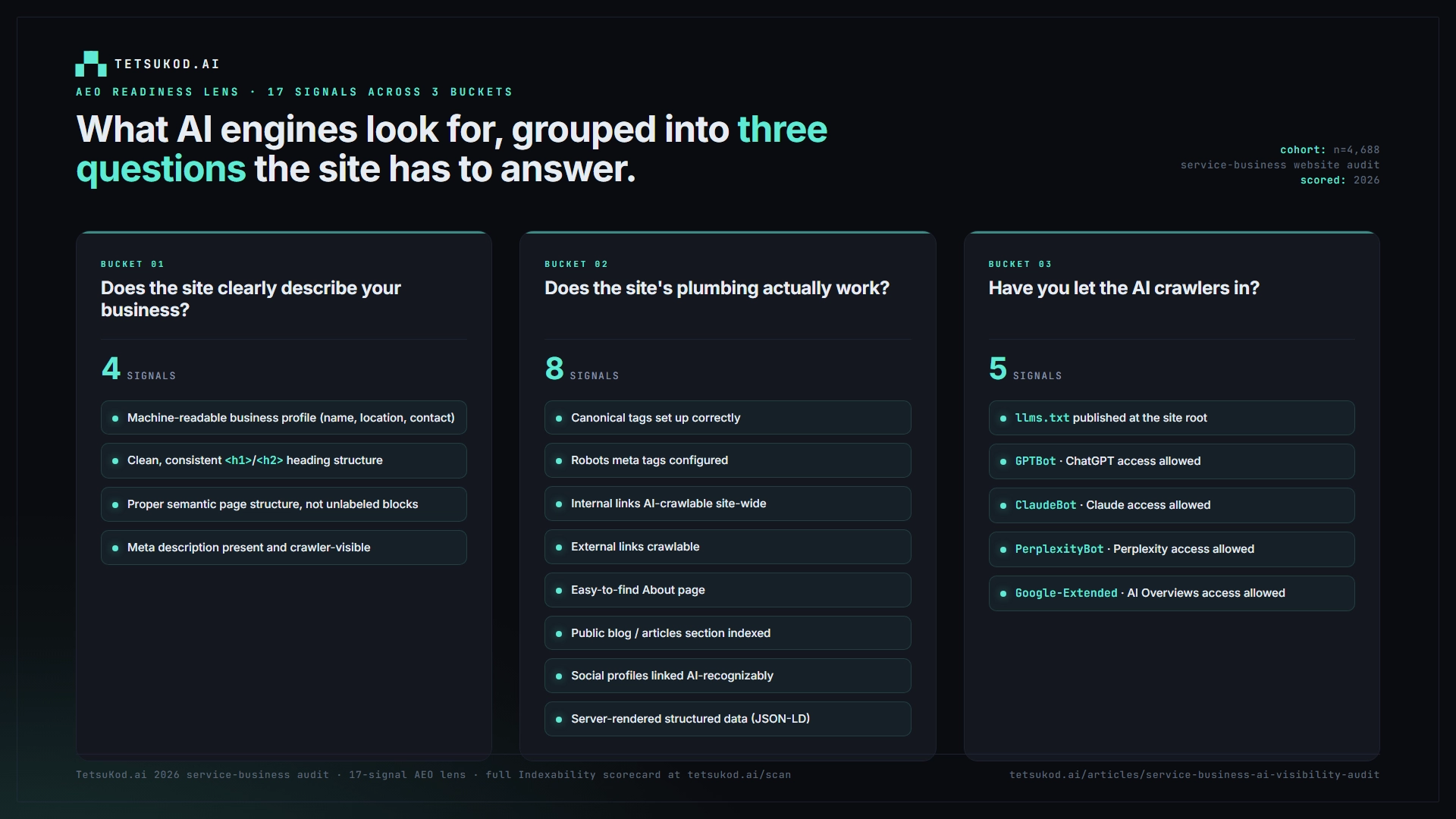
Does the site clearly describe your business?
- Whether your site tells AI systems what your business does, where it operates, and how to contact you — in a format machines can read.
- Whether your headings (page titles, section titles) are clean and consistent.
- Whether the site uses proper page structure instead of unlabeled blocks.
- Whether your meta descriptions are written and visible to AI crawlers.
Does the site's plumbing actually work?
- Whether your canonical tags are set up (these tell crawlers which version of a page to use).
- Whether your robots meta tags are correct.
- Whether AI crawlers can follow internal links throughout the site.
- Whether external links from your site are crawlable.
- Whether your site has an About page that's easy to find.
- Whether you have a blog or articles section that's publicly indexed.
- Whether your social media profiles are linked in a way AI can recognize.
Have you let the AI crawlers in?
- Whether
llms.txtis published (a file telling AI systems what's on your site). - Whether GPTBot (ChatGPT) can read your site.
- Whether ClaudeBot (Claude) can read your site.
- Whether PerplexityBot (Perplexity) can read your site.
- Whether Google-Extended (Google AI Overviews) can read your site.
The free scan gives you the 17-signal AEO score the moment your quiz finishes and the full Indexability breakdown by email. The next layer is a paid one-on-one review with Jacob Carpenter — he walks your full audit with you, names exactly what to fix and in what order, and calculates your Digital Opportunity Score: an estimate of how much traffic and revenue closing the gap on A-grade competitors in your vertical would net you, based on Apollo.io benchmark data for your revenue band.
TetsuKod.ai is one engineer who built the tools, runs the audit and closes the gaps himself.
What is llms.txt, and does my service business need it?
llms.txt is a small file at the root of your website that tells AI systems what your business does, where the canonical content lives, and what they're allowed to quote.
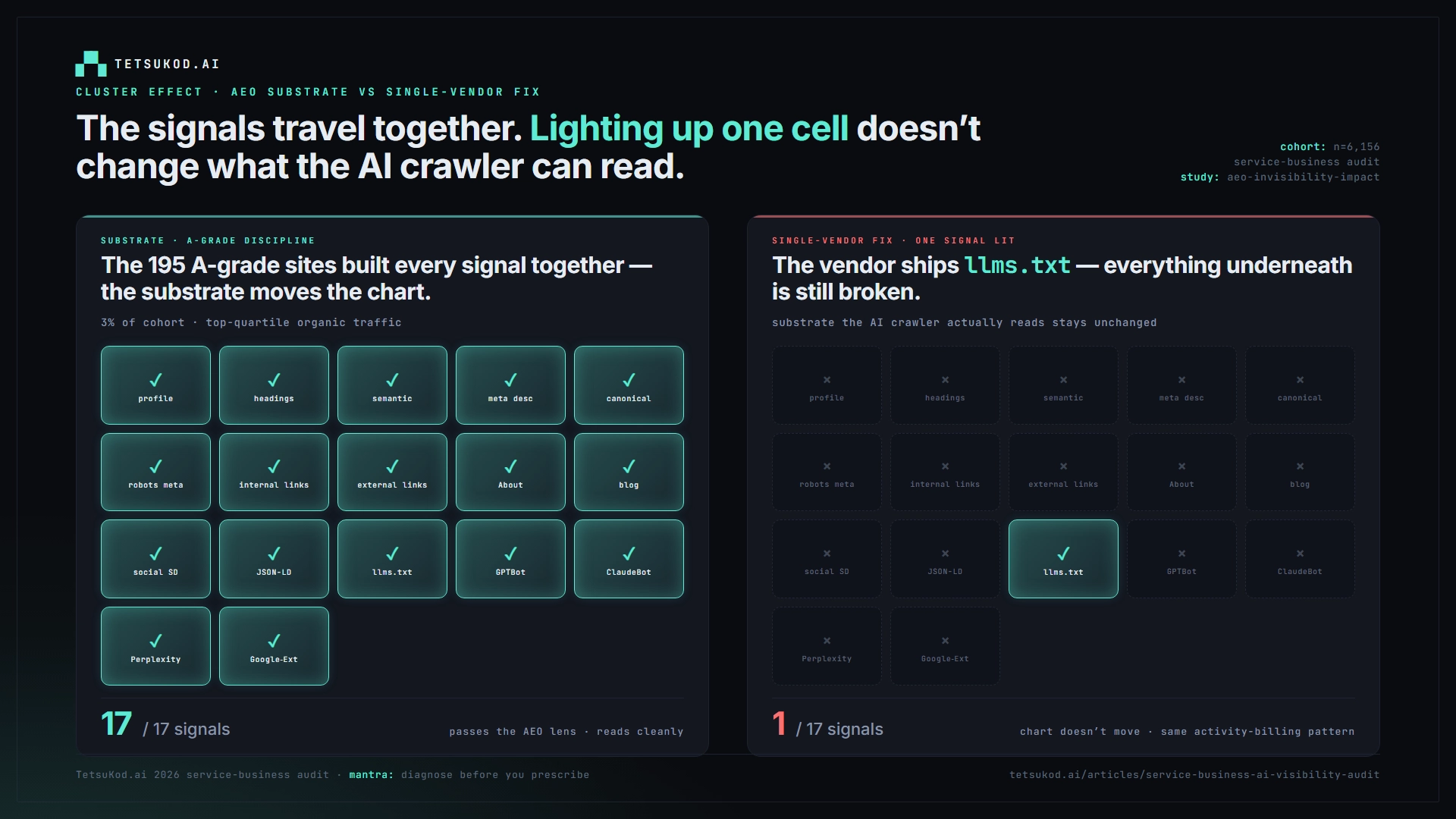
78% of the 6,156 service-business websites in TetsuKod.ai's 2026 audit haven't published one. The number is real and worth fixing. But on its own, llms.txt doesn't drive more traffic. The sites that publish it also tend to be doing the rest of the AEO work — clean headings, working structured data, proper canonicals — and that broader investment is what actually moves the needle.
If a vendor pitches llms.txt as the AI-visibility fix on its own, that's the wrong order. The cluster of signals matters; the single file doesn't.
How do crawl-budget problems hurt my AI visibility?
AI crawlers only have so much time per site. When your site has indexability problems — broken redirects, junk URLs, pages that shouldn't be public — the crawler wastes its time on those and skips the pages that matter. Customers searching for your services land on pages that don't represent what you actually do, or no page at all.
29% of the 3,882 indexability-scored service-business websites in TetsuKod.ai's 2026 audit have this problem. The sites that have it are missing a measurable slice of organic traffic — smaller per site than the visibility gap, but consistent across the cohort.
Crawl-budget waste almost never shows up by itself. The sites that have it also tend to have broken canonical tags, missing structured data, and weak heading structure — the same group of problems that fall apart together when the site's technical foundation is broken. Fixing one without the others rarely moves the chart. The fix is the cluster.
Why does my website need structured data?
Structured data is how AI engines read what your business does, where you operate, what services you offer, and where customers find your hours, reviews, and contact info. It has to load with the page — added by JavaScript afterward doesn't count, because the AI crawlers don't always wait for it.
27% of the 6,156 service-business websites in TetsuKod.ai's 2026 audit have no structured data at all. Adding it isn't a standalone traffic lever. The audit shows too small a gap to call it a traffic driver on its own. It's foundational — the layer the rest of the AEO work sits on. It shows up in the missing-traffic gap because it travels with the cluster, not because it moves the chart alone.
What does an AEO A-grade website actually look like?
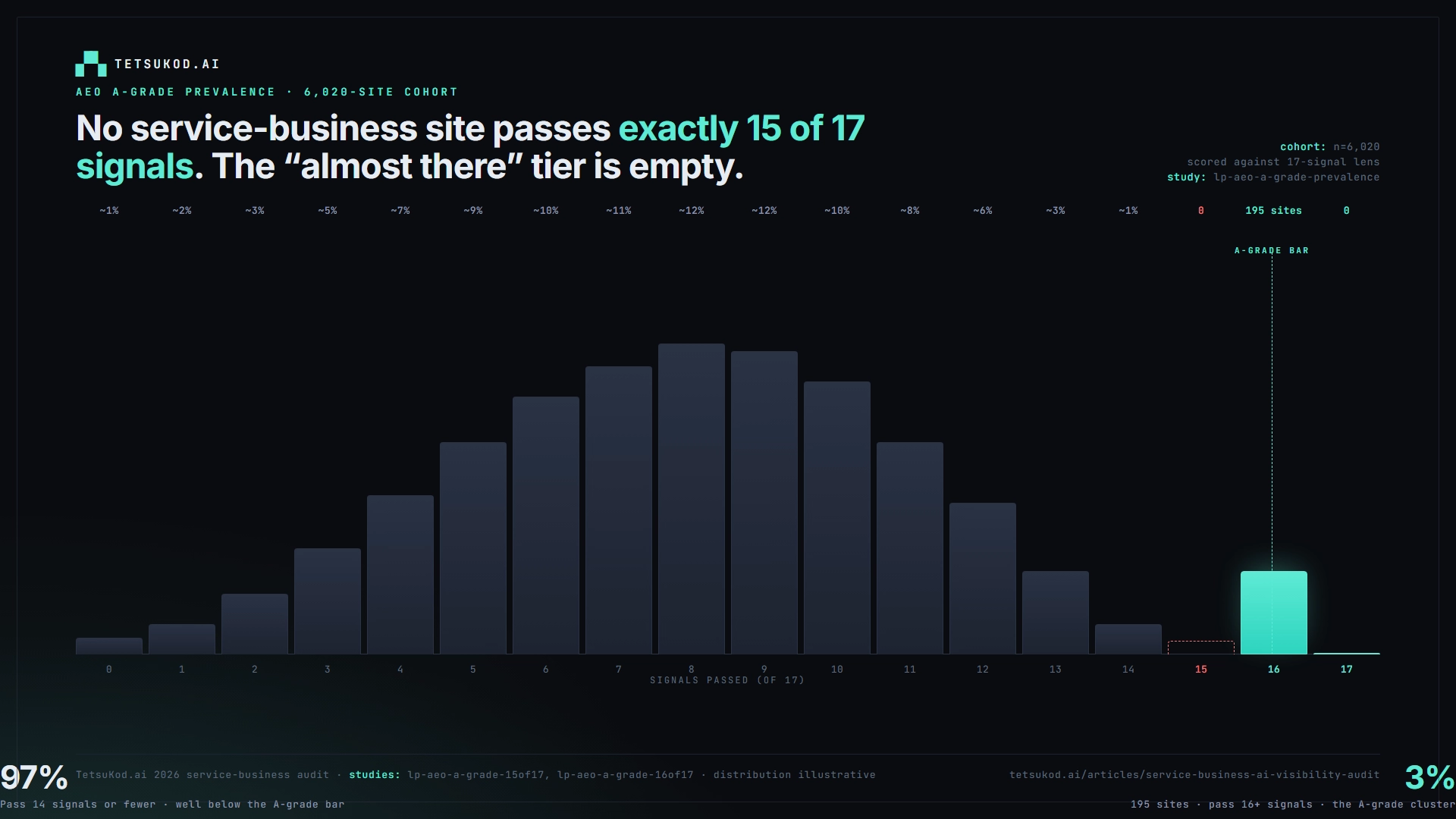
An AEO A-grade website passes 16 or more of the 17 readability signals. 3% of the 6,020 service-business websites in TetsuKod.ai's 2026 audit clear that bar — 195 sites out of just over 6,000. Those 195 sites land in the top quartile of organic traffic. The other 97% sit well below them.
There's no middle ground. The audit found no sites that pass exactly 15 of the 17 signals. Sites either go all-in on AEO and clear 16 or more, or they fall well behind. Operators at 13 or 14 signals aren't "nearly A-grade" — they're part of the 97% with measurable traffic deficits.
The path to A-grade is the cluster — the full signal stack working together. Adding one signal at a time rarely moves a site across that bar, because the businesses that clear it have built the engineering substrate underneath. The signals travel together because the discipline travels together.
What does failing the AEO readiness lens cost a service business in organic traffic?
Organic traffic — the search traffic real customers send your way — is what every study behind this article measures.
Three bars matter for service-business operators:
At the AI-readability bar — passing 85% or more of the 17-signal lens. Across the 3,324 service-business sites where we measured organic traffic, the median AI-visible site pulled 6,648 visits per month. The median invisible site pulled 461. That's roughly 14× the traffic, captured by the sites that pass the bar — and the gap shows up in every industry we tested.
At every business size. We sliced the cohort into five tiers — micro, small, medium, mid, and large — and the AI-visible cohort outperformed the invisible one at every tier. The biggest relative gap shows up at the micro tier (single-operator shops). The large tier still shows a large effect, which means a multi-location enterprise isn't insulated by scale either. "We're too small to need this" and "we're too big for this to move our chart" both miss the data.
At the AEO A-grade bar — passing 16 or more of the 17 signals. The 195 A-grade sites land in the top quartile of organic traffic. The other 97% sit well below them.
The 55% below the readability bar aren't losing traffic to next quarter's marketing campaign. They're missing the traffic the 45% above the bar are already capturing in their vertical. Every claim in this article maps to a piece of that gap.
You're missing out on real paying customers choosing your competition over you.
LP claim | Traffic gap for the failing cohort
55% not clearly visible | Primary — 14× median gap. AI-visible sites pull a median of 6,648 organic visits per month; invisible sites pull 461
78% missing llms.txt | None on its own — llms.txt is a maturity marker, not a traffic driver
29% wasted indexability | Measurable — smaller per site than the visibility gap, but consistent across the cohort
27% no server-rendered structured data | Foundational, not standalone — too small to cite as its own traffic claim
3% pass 16+ AEO signals (A-grade) | Top quartile — A-grade sites pull more organic traffic than the rest of the cohort
The two rows that don't carry a standalone traffic line — llms.txt presence and structured data on its own — are real prevalence problems but live inside the cluster. They show up in the missing-traffic gap because they travel with the substrate, not because each one moves the chart by itself. That's the same reason the cluster-effect section below carries the structural argument: the lens reads the substrate, the substrate reads the traffic.
Why does fixing one AEO signal at a time rarely move the chart?
Because the signals don't travel alone. The TetsuKod.ai 2026 audit data shows every claim in this article shares a cohort with the others.
The 195 sites that cleared the AEO A-grade — passing 16 or more of the 17 signals — didn't get there by adding llms.txt last week. They built the substrate over time: working canonicals, server-rendered structured data, clean internal link structure, an actively published blog, social structured data, and crawler access for the four named AI bots. The same group of sites scores well on every one of those checks because operators who care about one signal tend to care about all of them.
The flip side shows up in every problem cohort. Across the 6,156-site audit, the sites with indexability problems also fell short on canonical tags, server-rendered structured data, and heading structure — the same group of signals falls apart together when the substrate is broken. The roughly 4,720 sites missing llms.txt cluster with the same underperforming groups. Operators who don't know to look for llms.txt typically aren't being told to look for canonical tags either, because the vendor relationship was built around traffic charts instead of readability.
This is why adding one signal at a time rarely moves the chart. Publishing llms.txt on a site with broken canonicals doesn't unlock AI traffic on its own — the AI crawler still can't read the rest of the site cleanly. Adding structured data on a site the AI bots can't crawl doesn't surface the business in answers — the data doesn't reach the engines that read it. The 17 signals work as a stack. The discipline that produces the stack travels with it.
Trustless, substantiated, full transparency.
The path to A-grade is the substrate, not a sequence of one-vendor-fixes-one-thing engagements. If your current vendor is pitching a single AEO fix — just llms.txt, just schema, just speed — the pitch is shaped like the activity-billing playbook that produced the other 97%. Ask what the substrate looks like.
How we tested these numbers — Apollo-first, then widened
Every claim in this article was tested twice. We ran each backing study first against an Apollo-revenue-confirmed cohort, then widened the segment to include non-Apollo organizations — Google Places-sourced sites and other lead substrates — and re-ran every study.
The numbers stayed roughly the same. The 14× organic-traffic gap held. The A-grade prevalence held at 3%. The llms.txt-missing, structured-data, and indexability-waste prevalences all came in within a percentage point of the Apollo-first run. The cohort badge on the article reflects the wider run (about 6,156 sites on average per study); the verdict is consistent across both runs.
What this confirms: the verdict doesn't depend on which lead substrate we pulled the audit cohort from. Widening the segment didn't change the story, and that's the result we wanted before pinning the numbers in this piece.
Frequently asked questions
How can I check if my website is AI-visible?
Scan it for free at tetsukod.ai/scan. Enter your domain and start the AEO readiness quiz — while you take it, the scanner is auditing your site against 120+ signals in the background. When the quiz finishes you get your free 17-signal AEO score; the full Indexability breakdown lands in your inbox after the scan completes.
What share of service-business websites aren't clearly visible to AI answer engines?
55% — based on TetsuKod.ai's 2026 audit of 6,156 service-business websites. The 45% that are clearly visible pull a median of 6,648 organic visits per month. The 55% that aren't pull 461 — roughly 14× less, measured across the 3,324-site subset where we could verify traffic.
What does failing the AEO readiness lens cost a service-business website in organic traffic?
Across the 3,324 service-business sites where we measured organic traffic in TetsuKod.ai's 2026 audit, the median AI-visible site pulled 6,648 organic visits per month. The median invisible site pulled 461. That's roughly a 14× gap, and it shows up in every industry tested. At the stricter AEO A-grade threshold (passing 16+ of 17 signals), the 195 A-grade sites land in the top quartile of organic traffic; the other 97% sit well below them.
Does AEO matter for very small businesses or very large ones?
Yes. We sliced TetsuKod.ai's 2026 audit by business size — micro, small, medium, mid, and large. The AI-visible cohort pulled measurably more organic traffic than the invisible cohort at every size tier. The biggest relative gap shows up at the micro tier (single-operator shops). The large tier still shows a large effect — multi-location enterprises aren't insulated by scale.
Do most service-business websites have llms.txt?
No — 78% of the 6,156 service-business websites in TetsuKod.ai's 2026 audit don't publish llms.txt.
Does having llms.txt drive more organic traffic on its own?
No. In TetsuKod.ai's 2026 audit of 6,156 service-business websites, sites with llms.txt alone didn't pull more traffic. The sites that publish it are also investing in the broader signal stack that does.
How many service-business websites have indexability problems?
29% — based on TetsuKod.ai's 2026 audit of 3,882 service-business websites. Sites with indexability problems pull measurably less organic traffic than sites without.
How many service-business websites have no structured data?
27% — based on TetsuKod.ai's 2026 audit of 6,156 service-business websites with no machine-readable description of the business at all.
What share of service-business websites pass an AEO A-grade?
3% — defined as passing 16 or more of TetsuKod.ai's 17 AEO readiness signals. In the 2026 audit of 6,020 service-business websites, 195 sites cleared that bar. They pull measurably more organic traffic than the rest of the cohort.
How does TetsuKod.ai define an AEO-ready service-business website?
An AEO-ready website passes 16 or more of TetsuKod.ai's 17 readability signals — covering whether your site clearly describes your business in a format AI can read, whether the site's plumbing (canonicals, links, headings) works, and whether you've let the AI crawlers in (GPTBot, ClaudeBot, PerplexityBot, Google-Extended).
How recent is the dataset behind these numbers?
All five numbers were measured in TetsuKod.ai's 2026 service-business audit (6,156 websites). Every claim ships with the study behind it.
Where this leaves you
If your traffic chart hasn't moved this quarter and your current vendor can't explain why, your site is most likely in the 55% — pulling organic traffic at roughly 1/14th the median rate of the AI-visible 45% in your vertical. The fix is the substrate, not magic.
Step 1 — Get a free AEO scan and indexability preview.
Visit tetsukod.ai/scan. Enter your domain, take the AEO readiness quiz while the scanner runs in the background, and you'll see your free 17-signal AEO score the moment the quiz finishes. The full Indexability breakdown lands in your inbox after the scan completes.
Step 2 — Upgrade to your full Competitive Gap Breakdown.
If you want to know exactly what to fix and what it's worth to your business, book a one-on-one with Jacob Carpenter. You get your full audit walked through line by line, a Competitive Gap Breakdown showing every signal you're missing relative to A-grade competitors in your vertical, and your Digital Opportunity Score — an estimate of how much traffic and revenue you'd capture by closing that gap, based on real Apollo.io benchmark data for your revenue band.
No more waiting on results. No more team of 'experts'. Running your business becomes the focus again.
Step 3 — Close the gap on the competition.
The free scan tells you where you fall on the AEO readiness lens. The paid review tells you exactly which signals separate you from the A-grade competitors in your vertical, what closing that gap is worth in traffic and revenue, and what to ship first.
If you've been churning through agencies when all you really needed was one senior engineer, start with a Competitive Gap Analysis and find out what your stack is costing you. It's the right decision.